There’s a mini PC living under my TV. It started life as a homelab node, got demoted to a Jellyfin box, and these days it mostly runs indie games on the couch while the real gaming rig sits in the office gathering dust. So when Valve put a price on the new Steam Machine, $1,049, my first reaction wasn’t “shut up and take my money.” It was “wait, I already have a smaller version of this, and it cost me half that.”

That question wouldn’t leave me alone. The Steam Machine launches June 29, 2026, and it’s genuinely a nice little box. But a lot of people looking at that $1,049 are going to ask the same thing I did: do I need Valve’s cube, or will a gaming mini PC do the same job for less money and a lot more flexibility? I spent a few evenings pulling specs, prices, and benchmarks together to answer it properly, including the parts where the mini PC loses.
TL;DR
- The Steam Machine is a semi-custom AMD console: 6-core Zen 4 CPU, a dedicated RDNA 3 GPU with 28 compute units and 8GB of GDDR6, 16GB system RAM, from $1,049.
- Its real strength is that dedicated GPU. No integrated-graphics mini PC matches it.
- A $469 to $660 mini PC undercuts it hard for indie, esports, and older AAA games, especially if you stream the heavy stuff from a PC you already own.
- A $959 Ryzen AI mini PC gets you close on the graphics and does everything else a desktop does.
- Only a ~$1,440 mini PC with a real discrete GPU clearly beats it, and you pay for the privilege.
What the Steam Machine actually is
Let’s not pretend it’s a bad product. It isn’t. Valve built a small, quiet, semi-custom AMD box that boots straight into SteamOS and plays your library with zero Windows nonsense.
Here’s what’s inside, from the published specs. The CPU is a semi-custom AMD Zen 4 part, 6 cores and 12 threads, up to 4.8 GHz, roughly Ryzen 5 7540U territory. The GPU is the interesting bit: a semi-custom RDNA 3 design with 28 compute units at a sustained 2.45 GHz, paired with 8GB of dedicated GDDR6. Round that out with 16GB of DDR5 system RAM and either 512GB ($1,049) or 2TB ($1,349) of storage, all packed into a near-cube measuring about 156 x 152 x 162 mm.
The number that matters is that GPU. A dedicated RDNA 3 part with 28 CUs and its own 8GB of GDDR6 lands in the ballpark of a desktop Radeon RX 7600, which is a perfectly respectable 1080p and 1440p card. Valve originally pitched 4K60, then quietly softened that to “up to 4K” with FSR upscaling once reviews landed. In practice it’s a strong 1080p and 1440p machine. That’s the bar a mini PC has to clear.
And that’s where it gets interesting, because most mini PCs clear it from below, not above.
Most gaming mini PCs don’t have a real GPU
Almost every gaming mini PC you can buy today uses integrated graphics. The GPU shares system memory, has a fraction of the compute units, and sips power. That’s brilliant for a homelab box doing 22W idle. It is not the same animal as a dedicated 8GB GDDR6 GPU.
So when someone says “just buy a mini PC instead,” they’re quietly comparing two different classes of hardware. Here’s the fair version, side by side:
| Box | CPU | GPU | Dedicated VRAM | RAM | OS | Price |
|---|---|---|---|---|---|---|
| Valve Steam Machine | Zen 4, 6C/12T | RDNA 3, 28 CU | 8GB GDDR6 | 16GB | SteamOS | $1,049 |
| Beelink SER5 MAX | Ryzen 7 7735HS, 8C/16T | Radeon 680M (12 CU) | none (shared) | 24GB | Win 11 | $469 |
| Beelink SER9 Pro | Ryzen 7 255, 8C/16T | Radeon 780M (12 CU) | none (shared) | 24GB | Win 11 | $659 |
| GMKtec EVO-X1 | Ryzen AI 9 HX-370, 12C/24T | Radeon 890M (16 CU) | none (shared) | 32GB | Win 11 | $959 |
| Minisforum G1 Pro | Ryzen 9 8945HX, 16C/32T | GeForce RTX 5060 | 8GB GDDR7 | 32GB | Win 11 | $1,439 |
Read that VRAM column. Only one mini PC on the list, the Minisforum, has a dedicated GPU. Everything else is integrated graphics pulling from shared RAM. The integrated chips have come a very long way (a Radeon 890M genuinely plays modern games at 1080p), but none of them will go toe to toe with the Steam Machine’s dedicated RDNA 3 part at the same settings. Anyone telling you a $500 mini PC “beats” a Steam Machine on raw graphics is selling you something.
So why would you still buy one? Because “matches the GPU” is only one way to win.
Win #1: spend half as much and stream the heavy stuff
This is the play I actually use. A budget gaming mini PC handles indie games, emulators, esports titles, and older AAA on its own. For the genuinely demanding new releases, you stream them over your LAN from a gaming PC you probably already own, using Sunshine and Moonlight. The mini PC becomes a silent thin client that wakes the big rig on demand. It’s the same idea as GeForce Now, except the GPU doing the work is one you already paid for, sitting in the next room.
The Beelink SER5 MAX is the box for this. Ryzen 7 7735HS, Radeon 680M, 24GB of RAM, and it’s frequently under $470.
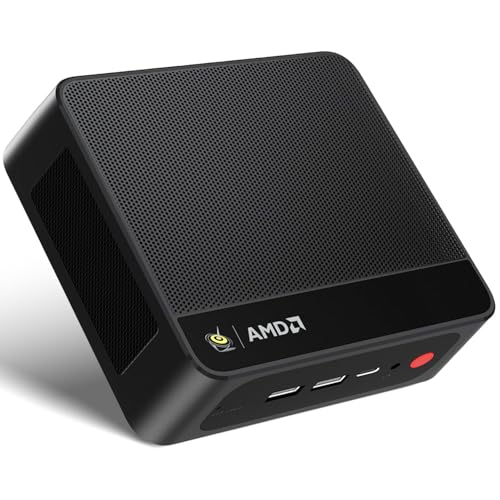
Its 680M won’t run Cyberpunk at ultra, but it’ll happily handle Hades, Stardew, Hollow Knight, older Assassin’s Creed, and most of your Steam backlog at 1080p. Pair it with Moonlight and the heavy titles stream off your desktop with about 20 to 30 ms of added latency, which is invisible for single-player and fine for anything short of competitive shooters.
You’ve spent $469 instead of $1,049, you can run Windows or Linux, and the box doubles as a media server when you’re not playing. That’s the whole pitch for the site, honestly: hardware that earns its keep doing more than one job.
Win #2: get close on graphics and do literally everything else
If streaming feels like a hack and you want one box that just does it all natively, step up to a current Ryzen AI chip.
The GMKtec EVO-X1 runs the Ryzen AI 9 HX-370, a 12-core chip with the Radeon 890M, 32GB of RAM, and an 80-TOPS NPU, for around $959.
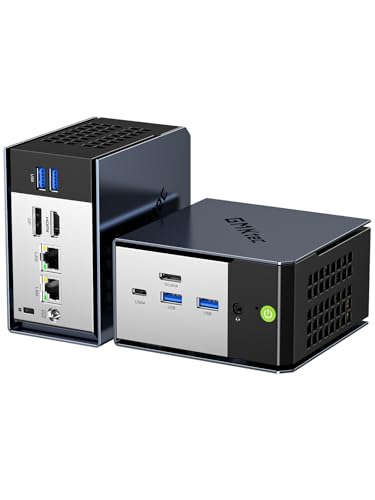
The 890M is the strongest integrated GPU in this price class, comfortably ahead of the Radeon 780M by around 20 to 30% in real-world 1080p gaming, and it plays modern games at 1080p without embarrassing itself. (There’s a stronger integrated chip, the Radeon 8060S in AMD’s Ryzen AI Max+ parts, but those boxes start north of $1,300 and leave the “cheaper alternative” conversation entirely.) It still won’t match the Steam Machine’s dedicated GPU at high settings, but it’s a genuine all-rounder: gaming, a local LLM, a dozen Docker containers, your work desktop, whatever.
For a middle option, the Beelink SER9 Pro (Ryzen 7 255, Radeon 780M, 24GB) sits at $659 and is the value sweet spot.
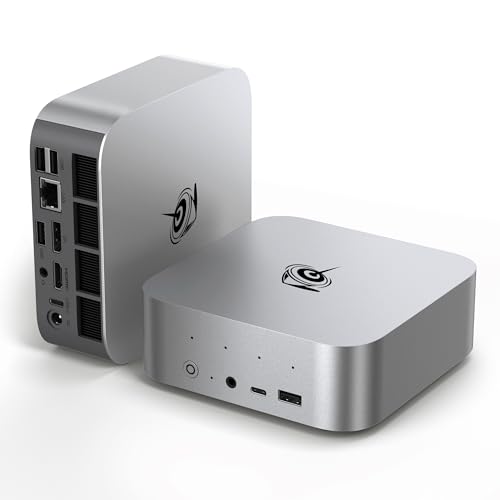
The 780M is a known quantity that’s been carrying handheld and mini PC gaming for two years. You give up a little graphics headroom versus the EVO-X1 and save three hundred bucks.
Neither of these is “cheaper than a Steam Machine and faster.” They’re “similar money or less, and infinitely more useful the other 20 hours a day you’re not gaming.” If your box only ever games, that flexibility is worth nothing to you, and you should keep reading. If it does double duty, it’s the whole reason to buy a mini PC at all, the same logic behind running a home lab on a mini PC.
Actually beating it, if you insist (and pay for the privilege)
If you want a mini PC that flat out beats the Steam Machine, you need a real discrete GPU, and at that point you’ve left “cheaper alternative” behind.
The Minisforum G1 Pro is the one to look at. It’s a console-shaped box with a Ryzen 9 8945HX (16 cores) and a low-profile GeForce RTX 5060 with 8GB of GDDR7, 32GB of RAM, 5GbE, the lot, for $1,439.
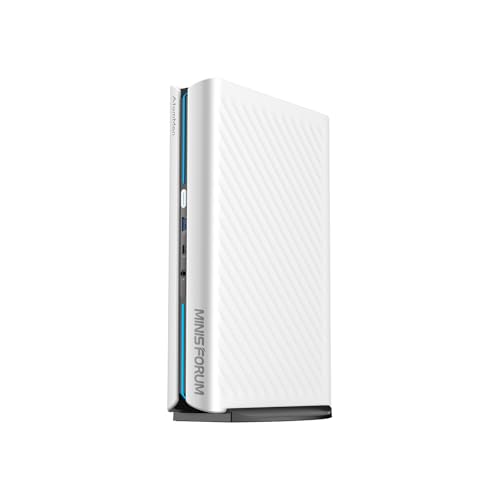
The RTX 5060 comfortably outruns the Steam Machine’s RDNA 3 GPU, and the 16-core CPU is in a different league (Tom’s Guide called it the box for ditching your console). It’s also bigger than a typical mini PC, the fans get loud under load, and it costs $390 more than the base Steam Machine.
So this is the honest version of “a mini PC beats it”: yes, but only when you spend more, accept more noise, and give up the silent-cube form factor. There’s no $500 box that quietly beats a dedicated GPU. Physics doesn’t work that way.
The asterisk on that $1,049 price tag
One detail the launch coverage mostly glossed over, and it cuts both ways. The Steam Machine ships with a single 16GB DDR5-5600 SODIMM, which means it runs in single channel out of the box. For a gaming box that’s a genuine downside, single-channel memory typically costs you somewhere around 10% of your frame rate versus a dual-channel setup. The flip side is that it’s not soldered: the second SODIMM slot is empty and user-accessible, so you can drop in a matching 16GB stick and run 32GB in dual channel. The SSD (NVMe 2230 or 2280) is upgradeable too. So it’s more open than people assumed, but you’ll want to crack it open and add a second stick to get the most out of it.
The storage tiers are where Valve actually locks you in: $300 to step from 512GB to 2TB, when a 2TB NVMe drive costs a fraction of that on its own.
The mini PCs split two ways. Some use soldered LPDDR5 or LPDDR5X you can never touch (the Beelink SER5 MAX’s 24GB sits in this camp). Others give you real SODIMM slots. The upside either way: most of these boxes already include 24 or 32GB, so you sidestep both the single-channel handicap and today’s spiking RAM prices, which are bad enough right now that even Apple raised laptop prices over them. Adding that second stick to a Steam Machine means buying memory at exactly the wrong moment.
Pro tip: if a spec sheet says LPDDR5 or LPDDR5X, that RAM is soldered and you’re stuck with the amount it ships with. If it says SO-DIMM or SODIMM, you can add your own later, same as the Steam Machine. Either way, 32GB in dual channel is the comfortable gaming target, and most of these mini PCs hit it straight out of the box without you touching a screwdriver.
When the Steam Machine is just the right call
I’m not here to talk you out of it. There are people who should buy the Steam Machine and not think twice:
- You want zero maintenance. SteamOS boots into Big Picture, updates itself, and never shows you a Windows update at 2am. A mini PC running Windows is a computer, with all the babysitting that implies.
- You value silence and the cube. Nothing on my list is as deliberately quiet and living-room-friendly as Valve’s box at that performance level.
- You don’t already own a gaming PC to stream from. Win #1 falls apart if there’s no big rig on the LAN. Without it, the budget mini PC is a weaker box, not a clever one.
- You just want to play and never tinker. If reading the word “Moonlight” made you tired, the Steam Machine is your answer. Buy it, plug it in, play.
The mini PC route is for people who want their hardware to do more than one thing, or who want to spend a lot less, or who already have a gaming PC and just need a silent couch terminal. That describes a lot of this site’s readers, the same crowd running multiple game servers on a single mini PC or hosting Minecraft on one.
FAQ
Is a mini PC actually cheaper than a Steam Machine? Yes, if you stay on integrated graphics. A capable gaming mini PC like the Beelink SER5 MAX runs around $469 versus the Steam Machine’s $1,049. The catch is you’re not getting the same dedicated GPU, so you lean on streaming or lighter games for the demanding stuff.
Can a mini PC match the Steam Machine’s graphics? Only a mini PC with a discrete GPU, like the Minisforum G1 Pro with its RTX 5060, and that costs more than the Steam Machine. Integrated graphics like the Radeon 890M get close at 1080p but don’t match a dedicated 8GB GDDR6 GPU at higher settings.
What’s the best budget Steam Machine alternative? The Beelink SER5 MAX at roughly $469. Pair it with Sunshine and Moonlight to stream heavy games from a desktop, and it handles everything else natively while doubling as a home server.
Will these mini PCs run SteamOS? You can install SteamOS or a community build like Bazzite on most of them, but they ship with Windows 11. The Steam Machine’s advantage is that SteamOS is tuned and supported on its exact hardware out of the box.
Do I need a discrete GPU mini PC for 1440p gaming? For native 1440p at high settings in modern AAA titles, yes, something like the G1 Pro. Integrated GPUs are happiest at 1080p. For 1440p on an integrated box, drop settings or use upscaling.
If I were buying today and didn’t already own a gaming rig, I’d take the Steam Machine and not overthink it. Since I do own one, the Beelink SER5 MAX plus Moonlight is the setup that’s actually under my TV, and it cost me less than half of Valve’s box while moonlighting as a media server. If you want one box to rule them all without streaming tricks, the GMKtec EVO-X1 is the sane middle. And if you genuinely want to beat the Steam Machine on raw frames, the Minisforum G1 Pro does it, for a price.
The Steam Machine is a good product. It’s just not the only small box that plays your library, and for a lot of people it’s not the cheapest or the most useful one.
Game on, tb 🎮
Last updated: June 2026